You have a packet of Chinese tea, but little of the label makes sense in English. Start with the name and the product’s own directions. You can decide on a brewing method after that; you do not need to begin by shopping for a full tea set.
1. Find the tea name
Look over the outside of the box, then the individual packets or tin inside. Photograph the front and the information panel before throwing any packaging away. Look for 品名 or 产品名称 (“product name”), and keep the Chinese characters alongside any translation.
Keep three readings separate: the tea name, the company wording and the pack quantity. The historical museum tin below shows that distinction on a real object. It does not supply a recipe for a modern gift.
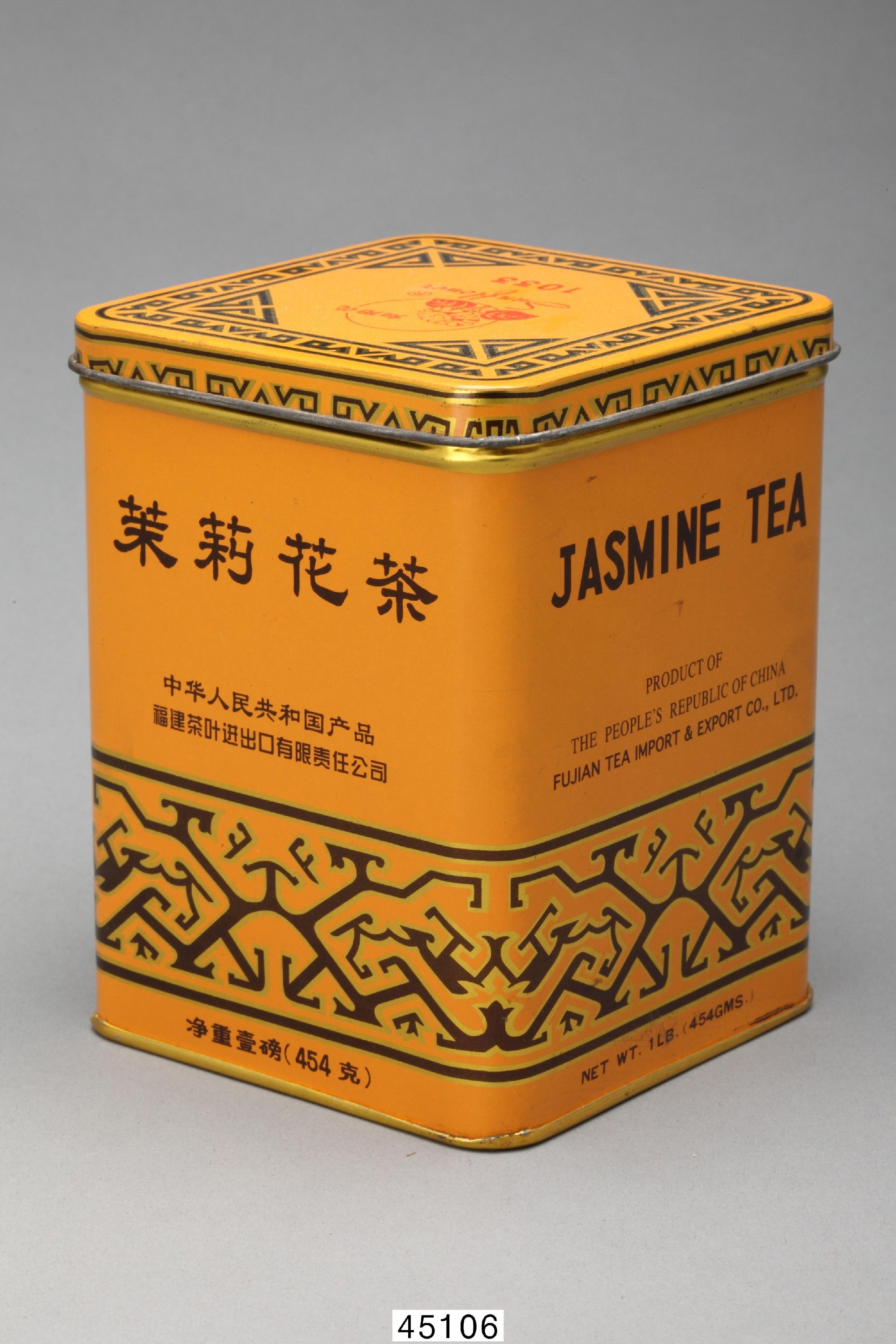
- 茉莉花茶 — jasmine tea. The tea name, printed across the upper front. “JASMINE TEA” appears on the adjacent face.
- The smaller company line. The line beginning 福建茶叶进出口 is company wording, not another tea variety.
- 454 克 — 454 grams. This is part of the pack’s net-weight statement near the bottom, not a brewing dose.
This is a museum collection example, not a current label or a TeaPlain brewing sample. Use it to recognise the words, not to judge the contents, grade or freshness. Tap the photograph to read it at full size.
Photo: National Museum of Korea, “Jasmine tea 1” via Wikimedia Commons (source record dated 19 July 1972; uploaded 2017), KOGL Type 1. Resized and converted to WebP; numbered reading markers added by TeaPlain. No museum endorsement is implied.

Useful words elsewhere on the packet
These are reading aids; layouts and wording vary. Consumer guidance recommends checking the packaging, including ingredients, dates and storage conditions.
Scroll sideways to read all three columns.
| Look for | Meaning | What to do with it |
|---|---|---|
| 品名 / 产品名称 | Product name | Copy the whole name, including the Chinese text. |
| 配料 / 配料表 | Ingredients / ingredient list | Check what is in the packet before choosing a tea guide. |
| 净含量 / 净重 | Net quantity / net weight | Read this as the pack amount, not the amount for one cup. |
| 生产日期 | Production date | Keep it separate from the shelf-life statement. |
| 保质期 | Shelf life | Read alongside the dates and stated storage conditions; ask the supplier if unclear. |
| 贮存条件 / 储存方法 | Storage conditions / method | Keep these instructions with the tea after opening. |
| 冲泡方法 / 饮用方法 | Brewing / preparation directions | Check the vessel, water amount, tea amount and timing together. |
A camera translation can help you find these fields. Keep a clear photograph and the original characters so you can check an odd translation with the giver or supplier.
Before moving on: save the complete name and a photograph of the information panel. Keep any inner sachet with its box. Use the front–panel–inner-packet reading sequence →
2. Match a guide — or ask
Start with this short selection of tea names. Match the printed name first, then read the guide’s scope before using its brewing suggestion.
Looking for another name? Browse or search all English tea guides in the encyclopedia →
For jasmine tea, check the tea base and shape: our glass proposal is for loose, green-base tea, not every product with “jasmine” in its name. For Zhengshan Xiaozhong, check whether the product says smoked or unsmoked. The individual guides explain these distinctions and their sources.
3. Use what you have
Choose your cup setup before following a recipe →
Know the name? Open the six first-cup methods for a glass or mug →
For the full preparation checklist, read How to brew Chinese tea in a mug →
A gaiwan is not required for every first cup. Glass brewing is documented by the China National Tea Museum; removable mug infusers are another practical way to separate leaves and liquid. Choose the operation that fits your tea and the product’s directions.
A mug with a removable infuser
Put the tea in the basket, add water using the tea’s directions, then lift the basket clear of the drink at the stated time or strength. Set it on a dish. Removing the wet leaves gives you a clear stopping point.
Use the infuser instructions for your tea. Our guides’ leaves-in-glass taste-check times are not interchangeable with a timed, basket-out method.
A heat-safe glass, with leaves left in
This is the operation used by our three current glass-brewing suggestions. Use the specified loose-leaf tea, actual water amount and uncovered vessel. Taste once it is cool enough to sip; a first taste-check is not an instruction to remove the leaves.
Choose the matching tea’s glass guide → These are editorial starting points, awaiting hands-on testing, and do not override product-specific instructions.
A brewing vessel, strainer and second cup
If the product’s method calls for pouring off the tea, strain the finished infusion into the second heat-safe cup. Transfer the drink you intend to serve rather than leaving the rest steeping among the leaves. This is a separation method, not the same operation as drinking from a leaves-in-glass brew.
For an infuser or a pour-off method, ask for directions that specify that method. Keep the vessel, actual water volume, leaf amount, temperature and time together. Avoid taking a leaf amount from one recipe and a steeping time from another.
Before pouring: have one method with a tea amount, actual water amount, temperature, timing and a clear action for the leaves. If you cannot match those conditions, ask for the missing directions. The diagrams above explain operations, not a TeaPlain brewing trial.
4. Adjust the first cup
Follow the one-change troubleshooting sequence →
Try one small preparation before opening every packet in the box. Keep a note of the tea, actual water amount, leaf amount and when you tasted it. The steps below are editorial troubleshooting suggestions, not results from a TeaPlain tasting trial.
- Too strong or bitter?
- Separate the liquid from the leaves to stop that steep. Next time, keep the water amount fixed and try less leaf or an earlier separation. Change one thing so you can compare.
- Too light?
- Check that you followed one complete method and measured the actual water amount. For the next trial, change the leaf amount or timing within the product’s directions, one at a time.
- The flavour is surprising?
- Check the product description before trying to fix the brew. In particular, a smoked product and an unsmoked one may call for a different purchase decision, not just a different steep.
Continue with the relevant guide: bitter Longjing, strong or smoky Xiaozhong, or bitter or faintly scented jasmine tea.
5. Put the packet away
Arrange storage and daily use after opening →
Keep the label and follow its storage conditions. For the three dry, loose teas covered here, protect the packet from moisture and strong odours, and close it properly after use. The storage sources distinguish tea types and packaging conditions; a Chinese gift box alone does not tell you whether its contents need refrigeration.
Read the matching storage section for Longjing, Zhengshan Xiaozhong or jasmine tea. For anything else, ask the supplier about that specific product rather than applying these conditions to all Chinese tea.
Editorial notes
Original source review: 15 October 2026; reading sequence, vessel instructions and links reviewed 17 October 2026. This is a researched starter guide, not a product authentication, safety inspection or hands-on brewing test. Numerical brewing proposals remain in the individual tea guides with their scope and conditions.
Research references and the original reader-question examples are retained in our internal editorial records. They illustrate questions, not a measured estimate of demand.