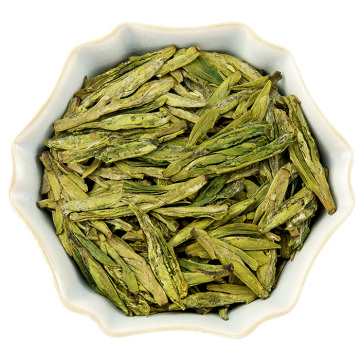
Start with the name
Longjing, also called Dragon Well, is a green tea. “Longjing” alone does not mean “West Lake Longjing.” The West Lake Longjing Tea Management Association distinguishes three Longjing production areas: Xihu (West Lake), Qiantang and Yuezhou. West Lake Longjing refers specifically to the Xihu area.
A useful comparison: Seven Cups sells a Da Fo Longjing from Xinchang, Zhejiang. Its product description gives that origin explicitly. It is an example of Longjing from outside West Lake, rather than evidence that every Dragon Well has the same origin or flavour.
Read the label
Before paying a premium for an origin claim, ask the seller for the named production area, producer and harvest year. If the listing only says “Dragon Well,” ask what it means. A flat leaf or an attractive photograph cannot establish the supply chain.
Keep an origin claim separate from a seller’s grade. Do not assume that “premium,” a star rating or two similarly named grades from different sellers are directly comparable. This guide does not certify a packet’s origin or assign a universal grade.
For a first purchase, choose a small sample with a clear description. Compare the price per gram alongside origin, year and pack size. We do not publish a market price range: we have not collected a comparable, dated set of offers.
Brew in a glass
Editorial starting point, awaiting hands-on testing. This is for loose leaves that remain in the glass while you drink. Follow instructions supplied for your particular tea first.
| What to use | Starting point |
|---|---|
| Vessel | Heat-safe glass, at least 300 mL capacity, uncovered |
| Tea | 2 g loose-leaf Longjing |
| Actual water | 250 mL (about 8.5 US fl oz) |
| Water temperature | 85–90°C / 185–194°F |
| First taste | After about 2 minutes, once cool enough to sip |
Add the tea and water. The two-minute mark is a taste check, not a requirement to finish the cup or a claim that the drink is cool enough. If the strength suits you, begin drinking; refill to the original water level when roughly one-third remains. Separate leaves and liquid if you need to leave it standing for a long time.
This is a deliberately light starting ratio of 1:125. The China National Tea Museum’s glass-brewing lesson uses a different example: 3 g with 150 mL water at 80°C. The CTMA also publishes a different cup method. These are complete methods with different conditions; do not combine one method’s leaf amount with another’s timing.
With a removable basket or a gaiwan, you can separate the infusion from the leaves. Start with the packet’s instructions for that vessel. Our glass taste-check time is not a gaiwan steeping time.
If your cup tastes bitter
Pour the liquid away from the leaves rather than letting it continue to steep. For the next cup, keep the water volume fixed and try less leaf or an earlier separation. Change one thing at a time so you can tell what helped. This is a practical adjustment to try, not a diagnosis of the tea’s quality.
Store the packet
Follow the packet’s storage conditions and best-before date. Keep the tea tightly sealed, dry and away from light and strong smells. For green tea kept longer, the storage sources discuss cold storage with suitable moisture-proof sealing. A loosely closed paper bag in a refrigerator is not that condition.
For frequent use, consider a small working portion so you do not repeatedly open the main supply. If a sealed packet has been chilled, let it return to room temperature before opening to reduce condensation on the leaves. An opened packet does not gain a new shelf life simply because it is refrigerated.
Editorial notes
Source material checked 15 October 2026. Research records are retained internally. The glass method and troubleshooting steps are editorial starting suggestions awaiting hands-on testing, not a TeaPlain tasting report. Follow the actual packet and keep different vessels, water amounts and steeping methods separate.