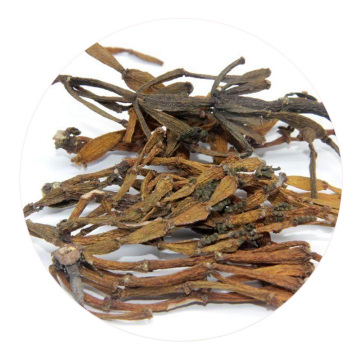
At a glance
Pang Xie Jiao, literally crab’s feet, refers here to a parasitic plant material associated with tea trees, not an animal ingredient or ordinary Pu-erh leaves. Establish the actual botanical identity and product suitability before considering use.
| Detail | What to know |
|---|---|
| Chinese name | 螃蟹脚 |
| Browsing group | Pu-erh directory (legacy association; this material is not tea leaves) |
| Associated origin | Old entry associates it with southern Menghai, Yunnan; host and packet identity unverified |
| Material form | Jointed plant stems; not tea leaves |
Taste and appearance
The inherited description records fresh green jointed stems becoming brown-yellow when dried, a clear yellow-green cup and a distinctive fresh aroma becoming medicinal-smelling with storage. These are old reference descriptions, not a verified tasting or identification guide. The shared cup photo is withheld because the same pixels appear under several unrelated tea names.
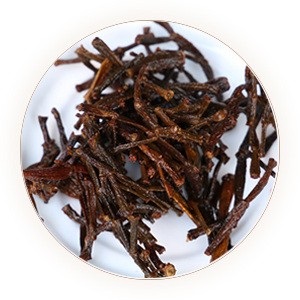
The original liquor photograph is withheld because identical pixels were assigned to another tea name. Its named identity could not be confirmed; the original file is preserved.
The cover is the original plant-material illustration. These images are not TeaPlain tasting samples or proof of origin, grade, age, authenticity or image rights clearance.
Grade characteristics
This preserves the earlier Chinese edition’s sensory comparison. It is not a complete verified current standard table and does not grade your packet. Plant material, growing area, processing and grade are separate details. Decorative star rankings are omitted.
On a small screen, scroll the table sideways to compare the grades.
| Feature | Extra grade (old comparison) | Grade 1 (old comparison) | Grade 2 (old comparison) |
|---|---|---|---|
| Stem form | Flattened long joints, prominent ridges and some green wording | Flattened long joints and even form | Flattened long joints and fairly clean form |
| Dry colour | Brown-yellow | Brown-yellow | Brown-yellow |
| Liquor | Clear bright yellow-green | Clear bright yellow-green | Yellow-green |
| Aroma | Fresh and lasting medicinal-like | Rich fairly lasting medicinal-like | Rich fresh |
| Taste | Full and smooth with strong sweet return | Smooth with strong sweet return | Smooth with sweet return |
| After preparation | Flexible and even stems | Flexible stems | Flexible stems |
This inherited comparison does not establish a food grade, safe dosage, botanical identity or clinical benefit. Medicinal-like refers to an aroma description. The last two old stem cells were incomplete; no new precision is invented.
Names and origin
The old name Bianzhi Hujisheng corresponds to Viscum articulatum. Independent botanical references recognise a parasitic plant with small scale-like leaves and flattened stems; it is separate from Camellia sinensis tea. These references do not authenticate the old photograph, require a centuries-old tea host, or establish a safe food serving. A laboratory extract study is not a human drinking-safety or clinical-benefit trial. The old ripe-Pu-erh classification conflicts with the stem material and is not retained as its plant identity.
Everyday benefits
No clinical benefit is established here. The actual research inspected concerns laboratory extracts and in-vitro antioxidant assays, not proof of a useful or safe daily drink. The former weight-loss, laxative, cooling and antioxidant promises are not retained as consumer benefits.
Who may enjoy this tea
For readers trying to identify a labelled ingredient and understand why it differs from tea. This entry does not recommend a serving or a medical use of unidentified mistletoe material.
When to take care
Do not consume an unidentified mistletoe product or substitute another species. Botanical references and laboratory assays do not supply a safe serving. Obtain qualified advice for actual intended use, medicines or a medical condition. Iron supplements: if a formula also contains tea, follow the prescribed directions and ask a pharmacist about separation; this does not validate the other plant ingredient.
How to brew
Product identity before preparation
The inherited 1:18, 100°C and ten-second leaf-tea method is not a verified serving for mistletoe material. It cannot establish safety or appropriate use.
| Detail | Evidence limit |
|---|---|
| Actual water | No verified product-specific volume obtained |
| Ingredient and dose | Botanical identity, suitable use and labelled serving must be established |
| Method | Obtain the actual identified product’s complete directions; no recipe is proposed here |
Any retained old preparation is awaiting hands-on testing and ingredient verification. Boiling does not resolve an unidentified ingredient.
Read the original illustration separately
Unsuitable generic leaf-tea graphic withheld. It labels about 5 g Pu-erh, warm teaware, boiling-water wetting and then 100°C / 212°F for about ten seconds. This is not a verified dose or preparation for mistletoe stems; no actual water is given. Its source is preserved internally, not offered as a serving recommendation.
For ordinary teaware options, see brew without a gaiwan. Keep each complete method together instead of selecting temperature, dose and time from different preparations.
Adjust your cup
No serving or flavour-adjustment recipe is proposed for unidentified mistletoe material. Do not increase its dose or steeping time to correct taste. Establish the botanical identity, intended use and complete product directions first.
How to buy
Seek exact botanical name, plant part, maker, full ingredients, intended food use and complete instructions. An association with an old tea tree does not prove identity, purity, permitted use or safety.
See buy your first Chinese tea for packet comparisons.
China price reference
Undated figures retained from the Chinese edition, in Chinese yuan (CNY). No original brand, batch, harvest or quotation date was recorded. These are not verified current retail quotes, a market average or manufacturer-suggested retail prices.
| Chinese-edition tier | CNY per 500 g (one jin) | Equivalent CNY per 100 g |
|---|---|---|
| Extra grade | 81 | 16.2 |
| Grade 1 | 49 | 9.8 |
Per 100 g is an arithmetic conversion, not a quoted packet. Do not infer a missing sensory or price tier. Compare actual growing area, style, harvest, roast, weight and channel. A currency conversion does not make a UK or US retail offer comparable to a China historical figure.
How to store
Original storage method
The old method describes conditional long-term storage, with duration depending on the tea, processing and actual storage history. It uses a clean, odour-free, shaded, relatively ventilated place, a clean carton or kraft bag without fully sealing the outer package, and original bamboo-shell wrapping where supplied. It keeps tea on shelving above floor level, away from walls, separates different types and batches, and checks it every few months.
Its targets are below 25°C / 77°F and below 70% relative humidity. These are inherited environmental references, not a validated universal ageing optimum, a target humidity to create, or a guarantee of remaining life. A partly closed carton is appropriate only where the surrounding conditions are clean, dry and suitable; it is not protection from a damp room. Follow the actual label and its specified conditions first.
In a UK or US kitchen
Choose a dry, stable place away from the stove, dishwasher steam, sunlight, spices, chemicals and food smells. Ventilation does not mean leaving tea exposed on a worktop or near an open damp window. Protect both the bulk pack and a small working portion from moisture and contamination. Do not deliberately humidify tea to imitate a factory fermentation pile. Check condition as well as dates; reject obvious mould, water damage or abnormal mustiness rather than trying to rinse it away. Long-term keeping is conditional, not a promise that every tea improves indefinitely. See storing opened tea.
Material exception: the copied plain-Pu-erh carton, temperature and humidity notes do not establish a suitable package or shelf life for mistletoe stems. Follow the identified product’s instructions. Do not deliberately age it as a tea cake.
Origin, processing and history
The original simple map says picking, sorting and sun drying. It does not specify species verification, edible-product controls, formulation or a validated process. Do not use it as home-harvesting or detoxification instructions. The former universal ripe-fermentation and ancient-host implications are unsupported.

Common questions
Is Pang Xie Jiao just another type of Pu-erh leaf?
No. The name here concerns mistletoe material. Botanical naming does not establish that an unidentified packet is suitable for drinking. Do not forage, substitute another mistletoe, or use an ordinary Pu-erh dose as a safety rule.
Can I move one number from this recipe into a different vessel?
A recipe for ordinary tea does not establish an appropriate serving for mistletoe. First establish exact identity, intended use and complete product directions; no serving is proposed here.
Compare Sheng Puerh, or browse the pu-erh tea overview.
Editorial notes and updates
Updated 16 October 2026. Valid original descriptions, sensory comparisons, prose and image methods, storage handling, China price figures and usable pictures are retained with their scope. Doubtful medical, ranking and exact historical claims are revised or omitted. Current full grade clauses and historical prices are not certified. Original Chinese-labelled graphics have English reading notes; no TeaPlain tasting or brewing test is claimed. Internal research and image audits record the decisions.